
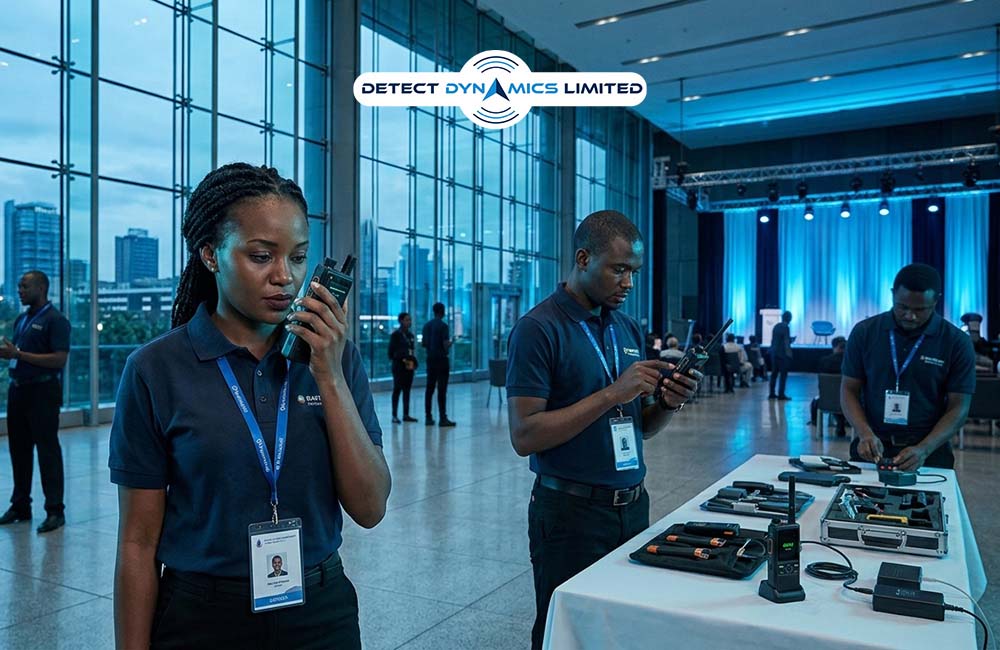
Here is a scenario every event organizer, logistics manager, and operational director in East Africa knows far too well.
It is 3:00 PM on a Saturday at a high-profile inteational summit in Nairobi. Thousands of attendees are filtering through security gates. The main stage lights flicker, requiring immediate technical intervention. Meanwhile, the VIP catering team needs confirmation on a schedule delay, and a perimeter security guard detects an unauthorized entry at Gate B.
What happens next?
In most traditional setups, mayhem ensues. The event coordinator desperately tries to dial the head of security, but the call rings endlessly—or worse, drops because local cellular networks are congested with thousands of attendee smartphones. The production manager sends a frantic text message into a buried WhatsApp group chat, hoping someone sees it before the stage goes dark. The catering supervisor is physically running across a two-acre venue to find the site manager.
Minutes bleed away. Frustration mounts. The seamless execution you spent six months planning begins to fray at the edges.
Now, imagine an entirely different reality.
Imagine your entire event team connected with a single press. Security alerts production in real time. Catering updates logistics without missing a beat. Managers coordinate cross-functional crews instantly without chasing people down. That is the revolutionary reality of mode push-to-talk technology.
Across East Africa—from the bustling event venues of Kenya and Rwanda to major commercial hubs in Tanzania and Uganda—the way teams communicate in fast-paced environments is undergoing a dramatic shift. And if you are still relying on standard mobile phone calls or legacy analog walkie-talkies, you are running today’s operations with yesterday’s engine.
The Hidden Cost of Operational Friction in East Africa
Let’s talk about what is actually costing your operations money, time, and reputation. It isn't a lack of talent or hard work; it is operational friction.
East Africa is currently home to one of the fastest-growing event, hospitality, and infrastructure sectors on the continent. However, the operational environment presents unique, recurring communication bottlenecks:
Traditional Analog Land Mobile Radios (LMR) used to be the default fix, but they come with severe limitations: strict line-of-sight distance caps, expensive dedicated radio tower infrastructure, zero data capabilities, and susceptible channel interception.
Enter mode Push-to-Talk over Cellular (PoC).
One Button, Total Control: How Mode Push-To-Talk Works
Mode push-to-talk bridges the gap between traditional radio simplicity and high-speed broadband intelligence. By leveraging existing 3G, 4G, LTE, and emerging 5G commercial networks alongside Wi-Fi, PTT devices give your team unlimited coverage range across entire cities—or even across East African borders—without requiring you to build or license private radio towers.
The operational mechanics are straightforward: you press a single dedicated tactile button, and your voice is broadcast instantly to a designated individual or an entire fleet of hundreds of devices in under a second.
No dialing. No waiting for rings. No navigating touchscreen menus with gloved or sweaty hands.
1. Built-in AI Voice Recognition: Clarity in the Noise
One of the most impressive advancements in mode PTT ecosystem devices is the integration of built-in AI voice recognition and real-time audio processing. East African outdoor venues, construction sites, and concert stages are notoriously high-decibel environments.
Integrated AI algorithms work continuously in the background, isolating human vocal frequencies while dynamically filtering out background noise—whether that is a 100-decibel speaker cluster, heavy engine rumble, or howling wind. Furthermore, smart voice assistance allows coordinators to issue hands-free voice commands, dictate quick text summaries to dispatch, or automatically translate voice broadcasts across multilingual crews in real time.
2. Multimedia Messaging and Live Video Dispatch
When managing complex operations, a voice update isn't always enough. A picture—or a live video stream—is often worth a thousand frantic radio transmissions.
Mode PTT handsets feature integrated cameras and high-definition screens. If a stage rigging looks unstable or an unauthorized vehicle is parked in a restricted catering lane, a team member can snap a high-resolution photo or launch a live-stream video call directly over their PTT channel. Dispatchers and team leads gain instant, eyes-on situational awareness, enabling them to make precise tactical decisions within seconds.
3. Extended Battery Life for Full Event Days
Event work in East Africa does not happen on an 8-to-5 schedule. Teams are on site setting up at 5:00 AM and breaking down gear long past midnight. Standard smartphones typically deplete their battery under continuous active use within 6 to 8 hours.
Purpose-built PTT equipment incorporates massive, high-density batteries optimized for low-power network standby and ultra-efficient push-to-talk audio streaming. Offering 18 to 36 hours of continuous operational power on a single charge, these devices ensure your security shift, production crew, and logistics staff stay fully connected through extended event schedules without searching for wall outlets or carrying awkward power banks.
4. Rugged Durability Built for Demanding Local Conditions
Tropical downpours in Kigali, fine dust conditions in arid staging grounds, or accidental high-altitude drops onto concrete during equipment rigging—East African field environments demand tough hardware.
Mode PTT handsets come carrying IP67 or IP68 ingress protection ratings and MIL-STD-810G military-grade certification. They feature drop-resistant reinforced casings, shatterproof displays, anti-glare screens readable under direct equatorial sunlight, and waterproof sealing. They are built to take a beating and keep communicating, dramatically lowering your total cost of ownership (TCO) compared to delicate commercial devices.
Real-World Impact: Transforming East African Operations
To understand the transformative power of this technology, consider how a unified PTT deployment redefines team dynamics across key sectors in the region:
Event Security & Safety
During large-scale gatherings, incident response times can make or break public safety. With integrated GPS/GLONASS tracking inside PTT units, central command dispatches the nearest security detail to an incident site instantly. If a guard encounters a high-risk scenario, pressing a dedicated physical SOS Emergency Button immediately overrides all channel traffic, sending an alarm and live location coordinates to all team supervisors.
Production and Technical Logistics
Coordinating lighting cues, audio engineers, artists, and stage hands requires split-second timing. PTT enables customizable call channels. The stage manager can talk to the entire event staff simultaneously or switch instantly to a private channel reserved strictly for the audio/visual crew—all on the same single device.
Cross-Border Logistics and Fleet Integration
For East African companies managing events or transporting high-value venue assets between Nairobi, Kampala, and Dar es Salaam, cross-border network integration used to mean lost signal. PoC PTT devices seamlessly switch across national telecom operators, allowing cross-border drivers and logistics coordinators to stay connected with central dispatch continuously without changing SIM cards or incurring prohibitive roaming delays.
Less Friction. More Control. Better Events.
At the end of the day, success in live operations isn't measured by how many plans you wrote down on paper; it is measured by how quickly and smoothly your team responds when reality deviates from that plan.
When you eliminate the friction of dialing numbers, fighting poor cell coverage, deciphering noisy audio, or replacing broken equipment, something remarkable happens:
Your team moves as a single, cohesive unit. Stress levels drop. Response times collapse from minutes to seconds. Your venue operations become tighter, safer, and infinitely more professional.
One button really can transform your entire event team. Less friction. More control. Better events.
References (APA Style)
